Nuclear Magnetic Resonance (NMR)
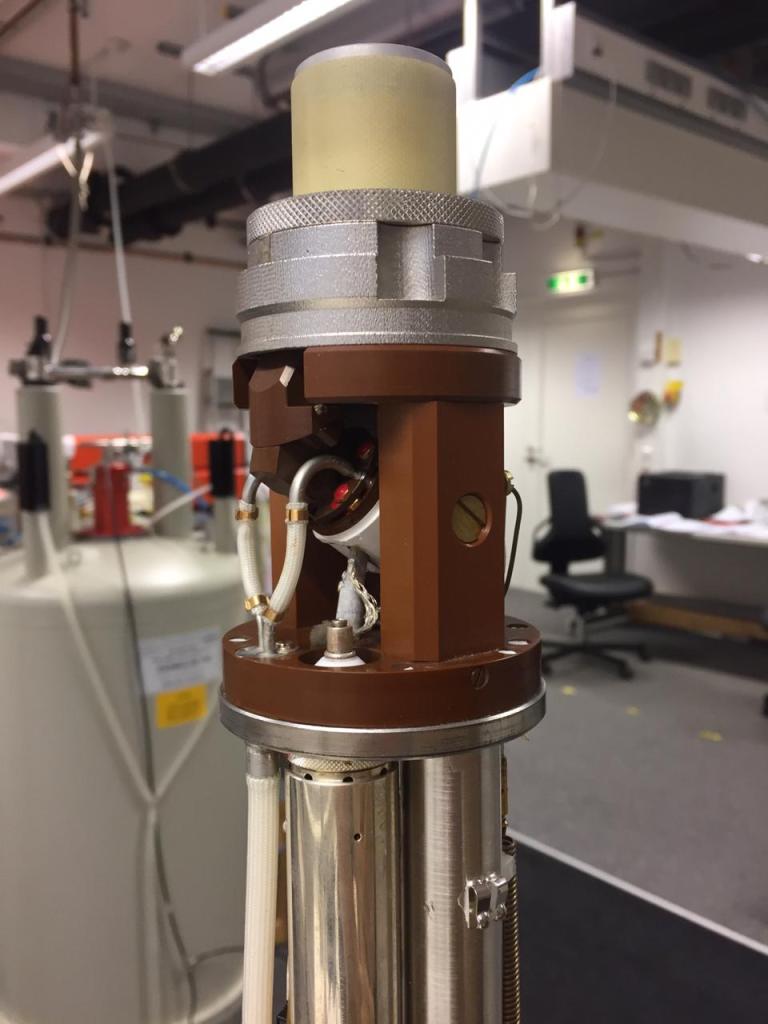
“Integration of solid-state NMR and hyperpolarization in Costa Rica should start in the academia, by integrating these topics in the curricula of students from different disciplines (…)”
Prof. Isaac F. Céspedes-Camacho
(Part of a Commentary published in Biophysical Reviews)
During the last years I have been working on different Nuclear Magnetic Resonance (NMR) applications, in liquid and solid state. Thanks to a strong collaboration with the group of Prof. Jörg Matysik (Universität Leipzig, Germany), I use and apply the photo-chemically induced dynamic nuclear polarization (photo-CIDNP) effect to understand the role of spin chemistry in artificial photosynthesis and also the hyperpolarized (HP) 129Xe for the characterization of different materials, such as aerogels and zeolites.
Since 2018, I have been teaching the course Spin Dynamics and Nuclear Magnetic Resonance at Tecnológico de Costa Rica, the first of its kind in the region for undergraduate students. This course is open to students from various disciplines and any public university in Costa Rica or abroad. My primary goal is to promote research, development, and innovation in NMR within the region by fostering a multidisciplinary environment.
With the acquisition of a 60 MHz benchtop NMR (Magritek®, 2022), our group has been actively exploring the low-field NMR regime. Our research has covered topics such as relaxation methods, field-gradient experiments with biological samples, reaction monitoring kinetics, and structural elucidation. Additionally, some students have begun designing and developing an hyperpolarizer to integrate with our benchtop NMR, further advancing our capabilities.
Aerogels: synthesis and applications
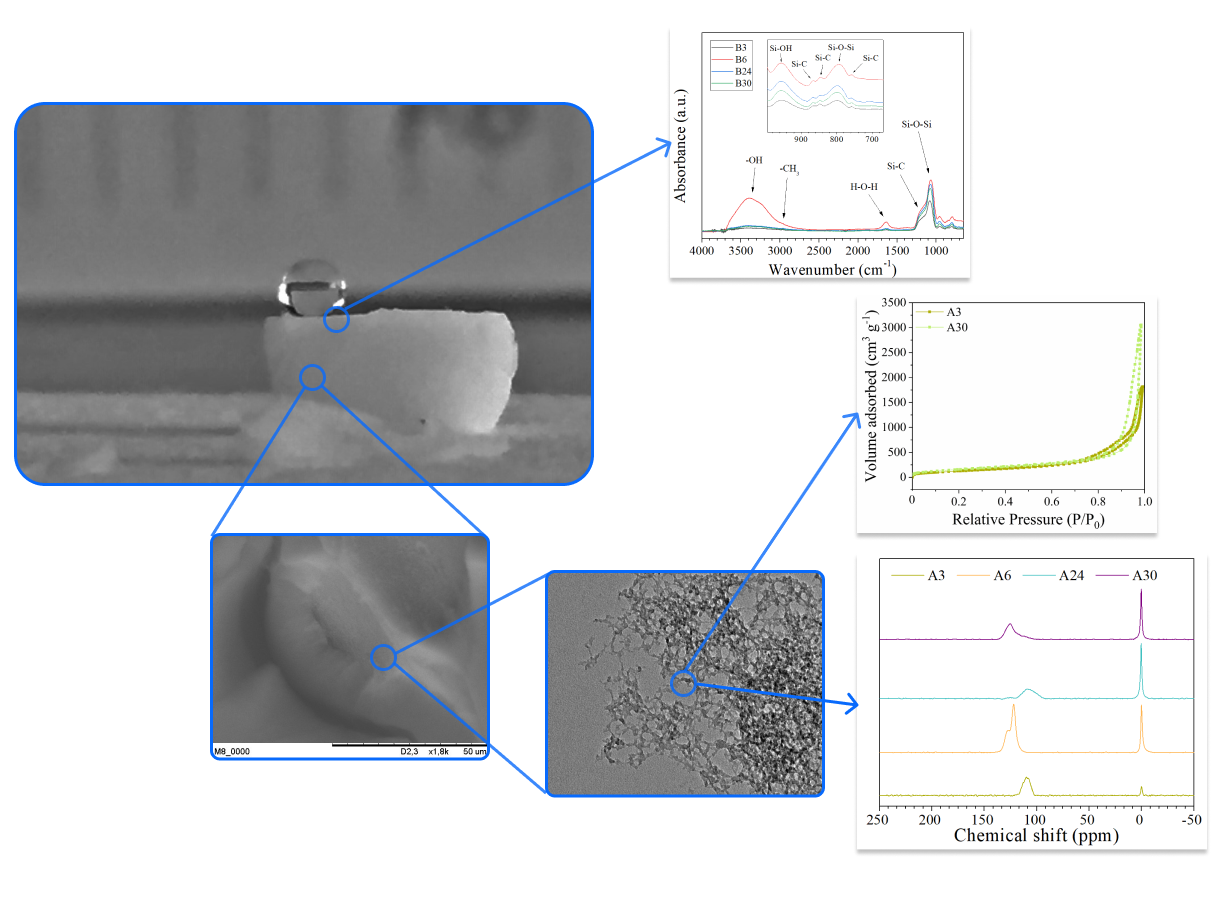
“This research focuses on synthesizing aerogels by varying functionalization agents as well as their concentrations. The goal is to analyze their hydrophobicity, specific surface area, and pore size distribution, among other characteristics to identify optimal synthesis conditions. These findings will enable the development of aerogels suitable for immobilizing of plastic degrading enzymes, advancing applications in biotechnology and environmental engineering”
Tatiana Alpízar-Rojas (part of her thesis abstract)
Silica aerogels are highly porous materials known for their large specific surface areas and wide pore size distributions. These versatile materials are synthesized using the sol-gel method and have a broad range of applications. In our group, we are working on the synthesis of hydrophobic silica aerogels designed to trap contaminants in water. Building on the discovery of the high PET-degrading potential of the PHL7 enzyme, we are optimizing the structural characteristics of these aerogels to serve as effective carriers for plastic-degrading enzymes.
Kinetic and Thermodynamic Studies

“…trying to find a correlation between chemical reactivity and the capacity to form adducts with different biomarkers”
Prof. Julio Casado Linarejos
Since my PhD in the group of Prof. Julio Casado (Universidad de Salamanca, Spain), one of my research areas has been the kinetic and thermodynamic studies on how different compounds can interact with DNA bases (or other biomarkers). Currently, I am running a kinetic study about the interaction of some pesticides and herbicides (e.g. mancozeb, glyphosate) used in Costa Rica and the DNA bases in order to provide kinetic and thermodynamic information that can be correlated with the mutagenicity/carcinogenicity of those compounds.
Faculty Advisor of the ACS TEC Synergy Chapter

“…starting a Chapter and building your membership and community is quite an accomplishment. It is gfreat to see you focused on growing as a team and making connections between your members.”
Part of a reviewer´s comment from the 2019-2020 Student Chapter report
The American Chemical Society (ACS) International Student Chapter at Tecnológico de Costa Rica was founded in 2019 by six students and myself as Faculty Advisor. Our ACS Student Chapter, called Synergy, is quite unique because is formed by non-chemistry majors. Currently, our Student Chapter consists of 13 students majoring in Engineering Physics, Materials Science Engineering, Environmental Engineering, Biotechnology, and Medical Imaging. The Student Chapter goals are: i) science outreach, ii) professional development of our members and iii) community development.
History, language, and literature

“…Ich erinnerte mich an wichtige Entscheidungen, die mir von Büchern kamen, an Begegnungen mit längst abgestorbenen Dichtern, die mir wichtiger waren als manche mit Freunden und Frauen, an Liebesnächte mit Büchern, wo man wie in jenen anderen den Schlaf selig im Genuß versäumte”
Begegnungen mit büchern, Stefan Zweig
Literature, languages, and history are complementary to my scientific work and teaching duties. I am passionate reader and a critic in construction. My main interests are poetry, classical literature and history. Some of my favourite writers are Oscar Wilde, Federico García Lorca, Stefan Zweig or José Ortega y Gasset.
I believe the best we can do with the new generations is to sow an interest in reading. On my lectures, and with my research students, I always try to create bridges between experimental and technological disciplines with the fine arts.
I am always happy to receive any suggestion of a new book or and updated article.
 Prof. Isaac F. Céspedes Camacho